Stepping Into A Victorian Wonderland – The Newly Re-opened RBGE Palm Houses


After a five-year restoration, the Palm Houses have reopened! Celebrating a landmark point in the most ambitious restoration project in the Garden's 356-year history, ensuring the protection of a unique and globally important plant collection.
Amongst the top four botanic gardens in the world, the Royal Botanic Garden Edinburgh and its iconic Palm Houses have long been at the forefront of global science and conservation horticulture, working to save species at risk of extinction since the 19th century. However, by 2021, substantial restoration was required to safeguard the buildings’ ironwork, stone, and glass, along with the priceless plants housed within.
Stepping Into A Victorian Wonderland – The Newly Re-opened RBGE Palm Houses

The Palm Houses at the Royal Botanic Garden Edinburgh (RBGE) boast a nearly 200-year history, evolving from an innovative early-Victorian hothouse into an iconic architectural landmark. Though often referred to as a single building, the site actually comprises two distinct, interconnected historic structures: the Tropical Palm House (built in 1834) and the Temperate Palm House (built in 1858). The dividing partition wall has been completely removed as part of the massive Edinburgh Biomes restoration project, creating a seamless walk-through, more light, and incredible architectural views.
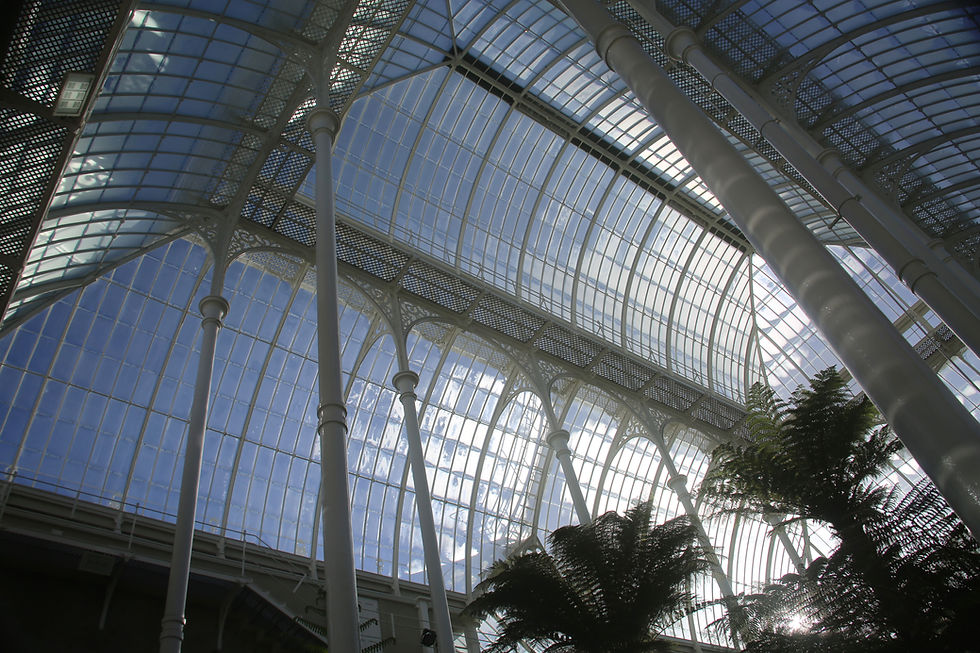
As part of the extensive restoration work, all 5,750 panes of glass were replaced, 600 m² of ironwork was fully restored or updated, and 500 m² of sandstone repairs were completed with replacement stones weighing up to a quarter of a tonne.
The tallest traditional stone-built Palm House in the world is home to almost 600 of the more tender plant specimens in Scotland’s National Botanic Living Collection, spanning 13,500 species from 152 countries. Discover the stories of the plants inside through an innovative multimedia visitor experience and multisensory digital tours including the Royal favourite palm, how palms were used in surviving a maroon, and how the Hawaiians slept like a log.

The opening was marked by the planting of the endangered lion plant (Valdivia gayana) from Chile. The Scottish Government’s Cabinet Secretary for Climate Action, Gillian Martin MSP, joined Professor Julia Knights, Regius Keeper of Royal Botanic Garden Edinburgh, to mark this important moment as the final specimen was planted in the restored Palm Houses. Experts from the Garden are playing a leading role in the propagation and cultivation of this species to ensure its future survival, following a collection of seeds in 2012 from a cave in Corral, Grota de la Aguada, in the province of Valdivia, Chile in collaboration with local partners. Known as planta del león (Valdivia gayana (Lion plant) in its native Chile. This small shrub bears large clusters of stunning magenta flowers, and it's estimated that there are fewer than five natural populations in the wild.
The specimens at RBGE are thought to be the only ones in cultivation outside Chile and come from a cave population which has subsequently been destroyed by the shade of an invasive ivy plant and a localised fire. Elsewhere in Chile, the species is threatened by habitat loss as much of its natural environment has been converted to commercial plantations of Pinus radiata, or Montery pine.
Though not yet formally evaluated by the International Union for Conservation of Nature (IUCN), the species meets the internationally recognised criteria for endangered status. At the Royal Botanic Garden Edinburgh, our Horticulturists have carried out intensive research on plants grown from seed (collected in 2012). This is helping them to better understand how to propagate and cultivate Valdivia gayana to ensure its continued survival and ongoing work with partners Fundación Chilco, a Chilean conservation charity. Read more on the first flowering at RBGE.

The renovated Palm Houses are a vital refuge for a number of rare and endangered species of plants from across the globe. Examples include the Three Kings vine (Tecomanthe speciosa) from New Zealand, one of the rarest plants in the world, and the Catkin yew (Amentotaxus argotaenia), a critically endangered conifer. The protection of these plants reflects the wider work of the Garden to preserve critical biodiversity for generations to come.
Other significant plants in the Palm Houses include;
The St Helena tree fern (Dicksonia arborescens) which is threatened by habitat destruction
The majesty palm (Ravenea sp.) - a potentially new species of palm in a genus that is full of threatened and critically endangered species
The Juan Bueno (Rhaphithamnus venustus) - an endangered flowering shrub from the Juan Fernández Islands – part of a remote Chilean archipelago
The palm leaf begonia (Begonia hemsleyana) - a threatened Chinese species of Begonia.
Royal Botanic Garden Edinburgh (RBGE)
Founded in 1670 as a physic garden to train medical students. The Royal Botanic Garden Edinburgh has grown into a world-leading scientific botanic institution with over 120 scientists working on research related to its National Botanic Collection. Today, comprising a herbarium of 3 million specimens, a living collection of 13,500 plant species, and a library and archive of rare books, paintings, photography, and art related to Botany.
Its mission to explore, conserve, and explain the world of plants is at the heart of national and international efforts to address the impact of biodiversity crisis, a climate emergency, to save and conserve as many plant species from extinction as possible, in collaboration with partners from across the globe.
Across all four Botanic Gardens in Scotland – at Benmore, in Argyll, at Logan, in Dumfries & Galloway, at Dawyck, in the Scottish Borders, and at Edinburgh - the Royal Botanic Garden Edinburgh is home to the National Botanic Living Collection of more than 13,500 species of plants. Together, the four botanic gardens welcome around a million visitors every year.
The A-Listed Front Range Glasshouses remain closed to the public, awaiting much-needed future restoration as part of the wider Edinburgh Biomes project. While awaiting repair, they are vital for the complex ‘plant decant’ process and are being used to temporarily store plants removed from other areas as they await renovation.
Royal Botanic Garden Edinburgh can be easily reached by a local Edinburgh Lothian Bus (8, 9, 23, and 27) from Hanover Street to outside the East Gate entrance on Inverleith Row.
For more information and to book tickets, please go to the RBGE website at rbge.org.uk/palm-houses.
With high interest, RBGE recommends pre-booking in advance to avoid disappointment. Members and Patrons of the Royal Botanic Garden Edinburgh go free.
Until next time...
Happy Travels,
Michelle x


Comments